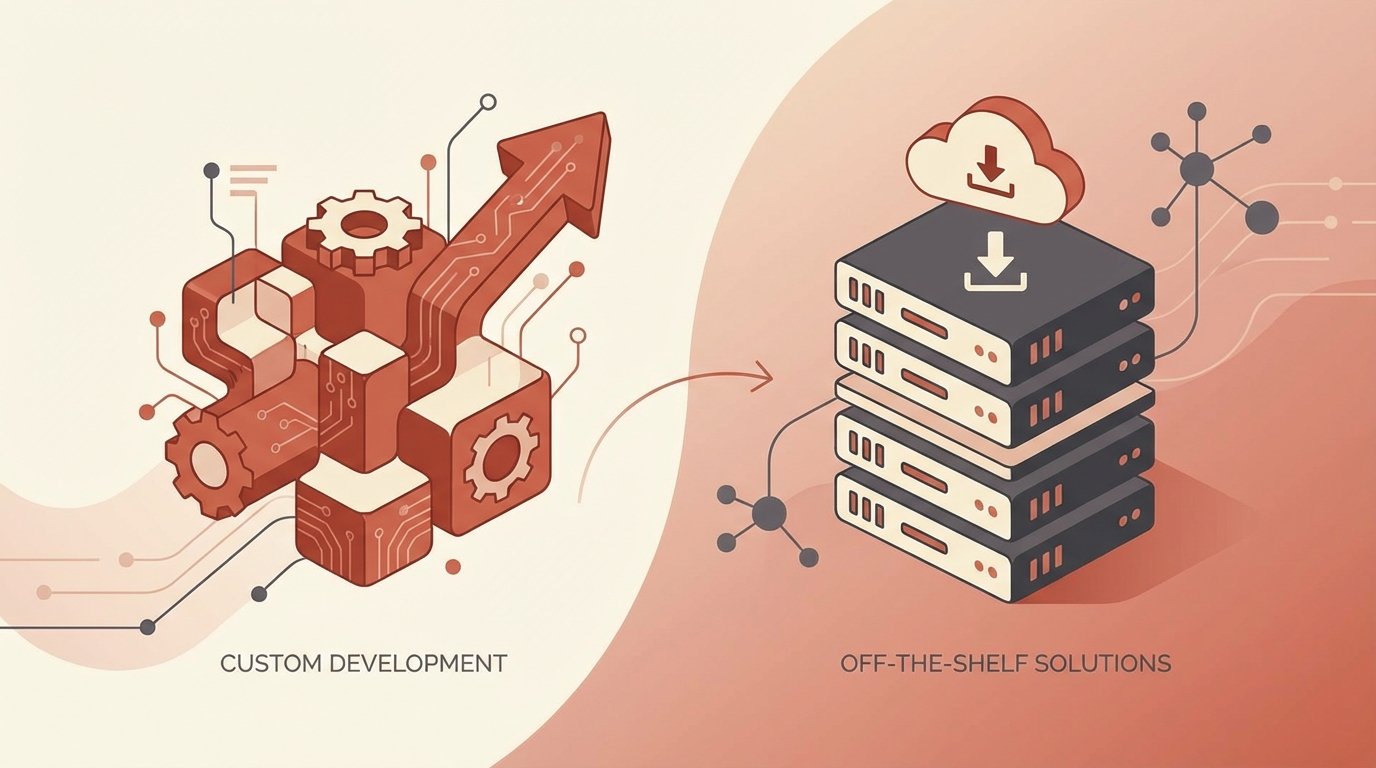
Compare custom software development and off-the-shelf solutions to determine the best approach for building your startup's minimum viable product (MVP).
Custom Software Development vs. Off-the-Shelf Solutions: Which Works Best for Your MVP?
When building a Minimum Viable Product (MVP), startups face a critical decision: should you opt for custom software development or use an off-the-shelf (OTS) solution? This choice significantly impacts your development time, cost, flexibility, and scalability. This guide will help you weigh the pros and cons of each approach to choose the right path for your MVP.
Understanding the Options
Custom Software Development
This involves building a software solution from scratch, tailored specifically to your unique requirements and business processes. You own the source code and have complete control over the design, features, and future development.
Off-the-Shelf (OTS) Software
These are pre-built software solutions designed for a broad audience with common needs. Examples include CRM systems (Salesforce), project management tools (Asana), or website builders (WordPress). You typically pay a subscription fee and use the software as is, often with some configuration options.
"The choice between custom and off-the-shelf isn't just technical; it's a strategic business decision impacting your speed, budget, and ability to differentiate." - Startup Advisor
Key Factors to Consider for Your MVP
When evaluating custom vs. OTS for your MVP, consider these critical factors:
- Speed to Market: How quickly do you need to launch?
- Budget: What are your financial constraints?
- Uniqueness of Needs: How specific are your requirements?
- Scalability: What are your future growth plans?
- Control and Ownership: How important is having full control over the software?
- Integration Requirements: Does your MVP need to connect with other systems?
Custom Software Development for MVPs
Pros
- Tailored Solution: Perfectly matches your unique business needs and processes.
- Competitive Advantage: Can incorporate proprietary features that differentiate you from competitors.
- Full Control & Ownership: You own the intellectual property and control the roadmap.
- Scalability & Flexibility: Designed to scale and adapt as your business grows.
- Seamless Integration: Can be built to integrate perfectly with other systems.
Cons
- Higher Initial Cost: Development requires significant upfront investment in time and money.
- Longer Time-to-Market: Building from scratch takes longer than implementing an OTS solution.
- Requires Technical Expertise: You need a skilled development team (in-house or outsourced).
- Maintenance Responsibility: You are responsible for all updates, bug fixes, and security.
When Custom Development Makes Sense for an MVP:
- Your core value proposition relies on unique, proprietary features.
- Existing OTS solutions don't meet your critical requirements.
- You have validated a specific need that requires a tailored workflow.
- Long-term scalability and flexibility are paramount from the start.
- You have secured funding to support the development costs.
Off-the-Shelf (OTS) Solutions for MVPs
Pros
- Faster Time-to-Market: Can be implemented relatively quickly.
- Lower Initial Cost: Often subscription-based, avoiding large upfront development expenses.
- Proven Functionality: Features have been tested by a large user base.
- Reduced Maintenance: The vendor handles updates, bug fixes, and security.
- Built-in Support & Documentation: Access to vendor support and community resources.
Cons
- Limited Customization: May not perfectly fit your unique workflows or needs.
- Generic Features: May lack the specific features needed for a competitive edge.
- Integration Challenges: Integrating with other systems can be difficult or impossible.
- Vendor Lock-in: Dependent on the vendor for updates, pricing, and support.
- Scalability Constraints: May not scale effectively or affordably as you grow.
- Recurring Costs: Subscription fees can add up over time.
When OTS Makes Sense for an MVP:
- You need to launch extremely quickly to test a basic hypothesis.
- Your core requirements are standard and well-addressed by existing solutions.
- Budget is a major constraint, and you need to minimize upfront costs.
- Your unique value proposition lies outside the software itself (e.g., in your service model).
- You are testing market demand before investing in custom features.
- You can build your unique value on top of an OTS platform.
Hybrid Approaches: The Best of Both Worlds?
Sometimes, a mix-and-match approach works best:
- OTS Core + Custom Extensions: Use an OTS solution for standard functions (e.g., user authentication) and build custom modules for unique features.
- Integrating Multiple OTS Tools: Connect several specialized OTS tools via APIs to create a functional workflow.
- Custom Front-end + OTS Back-end: Build a unique user interface that interacts with a standard back-end service (e.g., a CMS or e-commerce platform).
This can offer a balance between speed, cost, and customization but requires careful planning to ensure seamless integration.
Decision Framework: Custom vs. OTS for Your MVP
Ask yourself these questions:
Question Favors Custom Favors OTS
Is your core differentiator a unique software feature? Yes No
How quickly do you need to launch? More time flexible Extremely fast
Are your requirements standard or highly specific? Specific Standard
What is your initial budget? Higher Lower
How important is full control and IP ownership? Very important Less important
Are seamless integrations critical? Yes Maybe (if APIs exist)
What are your long-term scalability needs? High Moderate
Does a suitable OTS solution already exist? No Yes
Case Study: Startup A vs. Startup B
Startup A (Fintech):
- Problem: Needed a unique algorithm for risk assessment.
- Choice: Custom Development.
- Reasoning: The core value was the proprietary algorithm, which no OTS solution offered. They needed full control and flexibility.
- Outcome: Longer time-to-market but a highly defensible product.
Startup B (Local Services Marketplace):
- Problem: Connect local service providers with customers.
- Choice: Off-the-Shelf (WordPress + Marketplace Plugin).
- Reasoning: Core marketplace functionality was standard. Speed and low initial cost were priorities to validate demand quickly.
- Outcome: Launched MVP in weeks, tested market viability with minimal investment.
The Bottom Line: Align with Your MVP Goals
There's no single right answer. The best choice depends on the specific goals of your MVP:
- If your goal is to test a unique technological innovation: Custom development is likely necessary.
- If your goal is to quickly validate market demand for a standard service: An OTS solution might be faster and cheaper.
- If your goal is to test a specific workflow improvement: A hybrid approach might work.
Focus on what you need to learn with your MVP. Choose the path that allows you to gain that learning most effectively within your constraints.
Next Steps: Making Your Choice
- Clearly Define Your MVP Scope: What is the absolute minimum needed to test your core hypothesis?
- Research OTS Options Thoroughly: Identify potential OTS solutions and evaluate their fit, limitations, and integration capabilities.
- Estimate Custom Development Costs & Timeline: Get quotes from development teams or agencies.
- Analyze the Trade-offs: Use the decision framework above to weigh the pros and cons based on your specific situation.
- Consider a Phased Approach: Could you start with OTS and migrate to custom later, or vice-versa?
Ready to decide on the best approach for your MVP? Contact our team to discuss your specific needs and get expert advice on whether custom development or an off-the-shelf solution is right for you.
FAQ: Custom vs. Off-the-Shelf for MVPs
Q: Can I start with OTS and switch to custom later? A: Yes, this is a common strategy. However, data migration and rebuilding functionality can be complex and costly. Plan for this possibility from the beginning if it's likely.
Q: Is custom software always more expensive? A: Initially, yes. However, OTS subscription fees, customization limitations requiring workarounds, and potential switching costs can make OTS more expensive in the long run for some businesses.
Q: How does the choice affect attracting investors? A: Investors typically want to see validation. An OTS MVP can provide quick validation. However, for tech-focused startups, demonstrating proprietary technology via a custom MVP might be more appealing.
Q: What if no single OTS solution fits, but combining several might work? A: This is a viable hybrid approach, but be mindful of integration challenges, potential data silos, and managing multiple vendors/subscriptions.
Q: Does using OTS mean my product isn't innovative? A: Not necessarily. Innovation can lie in your business model, service delivery, target market, or how you combine existing tools, not just the software itself.